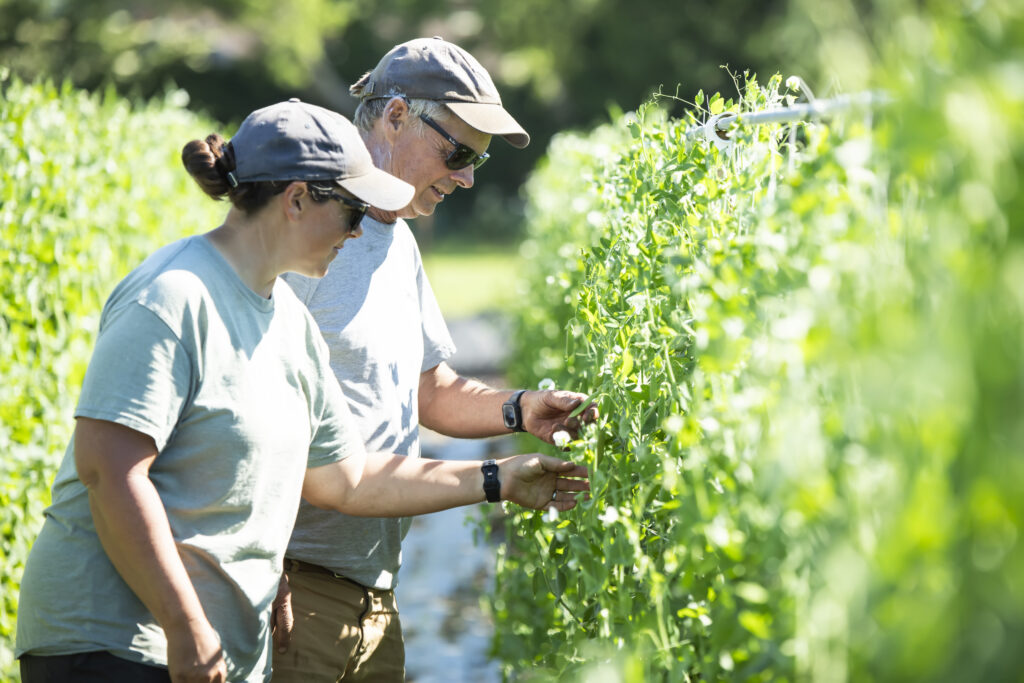
Not sure where to start? Or what to plant? Local growers lend their wisdom, whether you’re planting in a patio pot or garden plot.
Photos by Jessica Pohl
Last October, after a 12-hour trip home from San Francisco that capped a week of long workdays, I grabbed a shovel from my shed and started digging. I didn’t have much of a plan beyond a sense that this might be one of the last free weekends before the first frost. By Sunday night, I had a 350-square-foot plot, two raised beds left over from the previous year, and a winter’s worth of homework ahead of me.

What I learned reporting this story is that Rhode Island is full of free resources and people who want to help — and that a summer garden can be far more flexible than most beginners assume.
Start with timing. One of the most common mistakes home gardeners make — according to Jim and Michelle Garman, the owners of Garman Farm in Middletown — is calling it quits too early.
“We see a lot of people planting their garden on Memorial Day and then thinking that that’s the end, when they really could be going up to close to Thanksgiving,” says Jim Garman, whose farm grows USDA-certified organic produce.
By mid-July, a backyard garden is ready to begin a second act. Kale, cabbage, beans, carrots, and beets can all be planted for a fall harvest. Even in early August, there’s still time for turnips, bok choy, and another sowing of carrots, the Garmans suggest. And as Rhode Island’s fall season lingers, the window opens further. Last year, they were still harvesting tomatoes in October.
So, if you’re reading this with nothing in the ground (yet!), just know: You haven’t missed the season. You’ve just missed spring.
A sprawling backyard plot isn’t required for success, according to master gardener Laura O’Toole, who maintains a double plot in Middletown at Island Community Farm. Managed by Aquidneck Community Table, a single garden plot there measures 4-feet-by- 0-feet.
O’Toole believes almost anyone can grow something. “Everybody should garden,” she says. “Even if you have limited space, you should grow stuff in pots.”
Tomatoes, peppers, lettuce, and herbs all perform well in containers. And if space is tight, think vertically. O’Toole trains cucumber plants to climb trellises and grows lettuce beneath them, using the shade to keep the lettuce from bolting during the summer heat.

Kate Venturini Hardesty is the program administrator of the University of Rhode Island’s Cooperative Extension, the outreach and education arm of its College of Environment and Life Science. The key, she says, is understanding what happens below the soil.
“Whatever you see above ground is proportionate to what’s below ground,” says Hardesty.
In practical terms, that means matching plants to containers. A three-gallon pot can comfortably support a pepper plant. A five- gallon container paired with a trellis can produce “pounds and pounds of cherry tomatoes,” she says. Large root crops, such as potatoes and turnips, generally need more room than containers can provide.
Once you’ve figured out where to grow your garden, the next question is what to grow. The answer from the experts I spoke with was remarkably simple: grow what you want to eat. One of the most common mistakes the Garmans see is gardeners planting too much of everything. Overcrowding is their most frequent critique of backyard plots.
“Grow what you like,” Jim advises, “two or three things that you really like.” Be aware of how much a plant typically yields. A single zucchini plant, for example, probably will produce enough to feed a family, he says.
The same principle applies to garden size. Thriving gardens don’t have to be large. “Successful gardens can be a 5-foot-by-5-foot plot,” Hardesty said, “because it’s a lot easier to be a successful gardener when you nail it versus being really ambitious.”
For beginners starting with seeds she recommends planting lettuce, radishes, and peas. Tomatoes and peppers are often easier to grow from seedlings.
Variety can matter as much as the crop itself. For home gardeners, the Garmans recommend choosing disease resistant types, which seed catalogs clearly mark. They steer people to Johnny’s Selected Seeds, a Maine company whose listings detail spacing, days to harvest, and disease resistance for nearly anything that grows.

Experienced gardeners also think about pairings. O’Toole practices companion planting — growing crops that help one another. She lets strawberries spread as ground cover around her asparagus stalks. Experimenting, she says, is part of the appeal of home gardening.
“Every year I’m trying something new,” says O’Toole. “And sometimes it works great, and sometimes you don’t get eggplant.”
The one thing gardens can’t do without is the sun. Eight hours of direct sunlight a day is the single most important factor for growing food, Hardesty said. Next comes proper watering and soil knowledge.
Overwatering is the most common mistake gardeners make once they’ve planted, according to the Garmans; it’s how they accidentally make life harder for themselves.
“There are very few plants that want their feet wet,” says Michelle. “They want a nice soaking, and then they want to be able to dry out and stretch their roots down.”
The number one question Hardesty fields throughout the growing season is, “What’s wrong with my plant?” Eight times out of ten, the answer is too much or too little water, she says
Rhode Island receives roughly the amount of annual rainfall most vegetable crops need, but midsummer often brings dry stretches that require supplemental watering. When that happens, gardeners are better off watering deeply and infrequently than providing a quick daily sprinkle. Deep watering encourages roots to grow downward in search of moisture, creating healthier and more resilient plants.
Soil testing is worth the effort, the experts agree. URI Cooperative Extension offers free testing at community events throughout the growing season. Gardeners submit a small, dry soil sample and receive information about its texture, drainage, organic matter needs, and pH levels. Volunteers are available to explain how to amend the soil based on what the gardener hopes to grow.
The Maher Center on Aquidneck Avenue in Middletown will offer soil testing on Saturdays, July 11, Aug. 8, and Sept. 12, from 10 a.m. to noon.

If it all sounds overwhelming, you don’t have to figure it out alone. Rhode Island’s gardening community is particularly accessible. The URI Cooperative Extension’s Master Gardener program runs much of the support, all of it free. Its Gardening and Environmental Hotline (gardener@uri.edu or 401-874-4836) accepts photos of residents’ ailing plants and provides science-based remedies within a day or two.
Community gardens, farmers markets, and neighborhood gardeners can all serve as informal teachers O’Toole says she has learned some of her most valuable lessons simply by talking to the growers behind market tables. That spirit of shared knowledge is one of the benefits gardening offers beyond the harvest itself.
A former sociology professor at Salve Regina University, O’Toole has spent much of her career studying how people relate to one another and to the environments they inhabit. Gardening, she says, strengthens both relationships.
“There’s research on gardening as something that is beneficial mentally and physically for people,” says O’Toole. “Getting your hands dirty is actually a good thing for you … we are better and healthier individuals — and actually better consumers — and we have more respect for the farmers among us if we’re doing the work ourselves.”
The fresh herbs, fruits, and vegetables produced in local gardens are a bonus. The deeper reward is becoming more connected to the food we eat, the people who grow it, and the place where we live, the experts agree.
As for my own plot, I’m following the advice to grow what I’d actually eat. I put in four tomato plants — San Marzano and Roma, because I like making sauce — surrounded by marigolds, plus a row of peppers, two trellised cucumbers, and seeded carrots, onions, cilantro, and basil. Most of it started as seedlings from Greenview Farm in South Kingstown. The raised beds hold lettuce, kale, shishitos, and strawberries, along with garlic that I planted last fall. Now, I just have to keep it all alive; will report back this fall.