The Aquidneck Island-based organization, in collaboration with the Newport Restoration Foundation, is hosting an immersive and thought-provoking exhibit at the Vernon House on Clarke Street
Photos by Dave Hansen
Inside the Vernon House on Clarke Street in Newport sits a convergence of history, performance, craft, and conversation. Collectively, these elements tell the story of the historic house and one man who lived there for a time, a man named Cato Vernon.
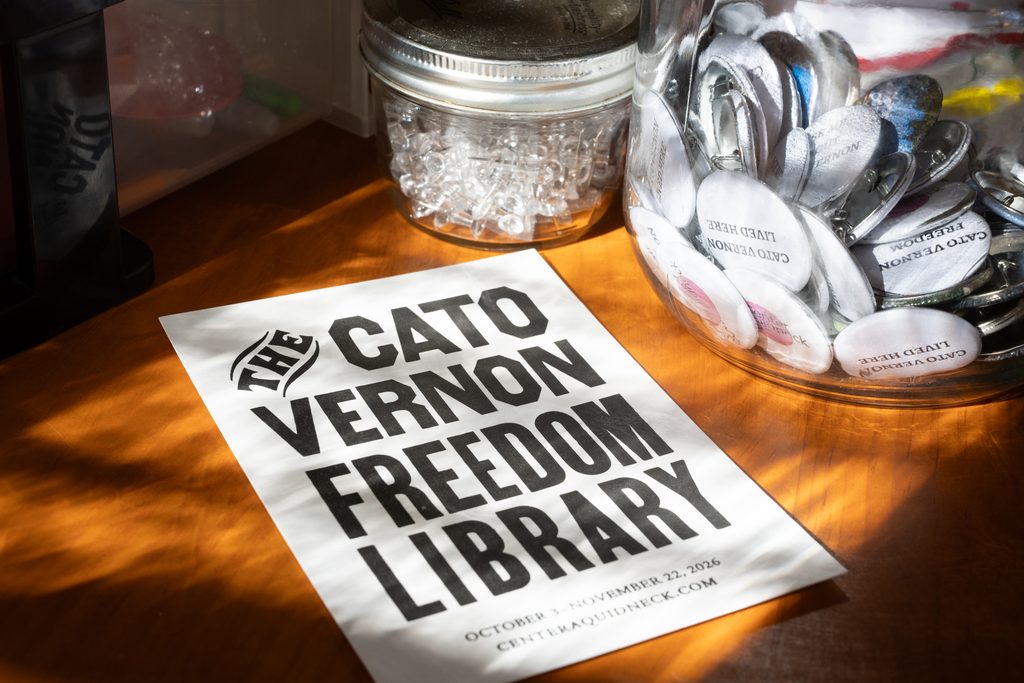
Cato was the inspiration for the Cato Vernon Freedom Library, the latest project of Center Aquidneck, in collaboration with the Newport Restoration Foundation. The project asks visitors to imagine what life was like for Cato, who lived 250 years ago, as both an enslaved man and a soldier who fought for his own freedom, and also to think about how that history shapes the world we live in today.
The exhibit is immersive and thought-provoking, which are pillars of Center Aquidneck’s work. Center Aquidneck was founded in 2024 by Rebecca Noon and Jed Hancock-Brainerd, partners in both life and their creative pursuits. The two have a theater background and from 2009 to 2019 ran Strange Attractor, a traveling theater company. They met in 2008 at the London International School of Performing Arts while studying in the Lecoq Based Actor Created Physical Theater program.
“We met in grad school as collaborators and then fell in love as people,” says Noon, as Hancock-Brainerd gazes at her fondly, nodding in agreement. We’re gathered on a Monday evening in late October, at the start of a conversation that would last two hours.
Hancock-Brainerd was born in Newport, and Noon moved here when they left London. Aquidneck Island has been home ever since, barring a brief stint in Minneapolis from 2019 to 2023. While in Minneapolis, they knew they would eventually return to Aquidneck Island and began wondering what their next creative pursuit would entail.
Having spent the better part of two decades traveling around the country and staging programs in black box theaters, they were ready for a change. They developed the idea of bringing theater — or theater-infused projects — to nontraditional stages.
Center Aquidneck became “a container for our arts practice,” says Noon, noting it’s not a nonprofit but rather an entity that exists so they can bring projects to life. “Our art practice is not a business — it’s an obsession.”
“This is supposed to fit into [our] life in a way that feels good and is generative,” she adds. “The quality of the work only gets better.”
Center Aquidneck emerged as a place-based project with an emphasis on “persistent optimism.” Its name refers to both the idea of “centering” Aquidneck Island, and allowing nonconventional spaces around the island to serve as a performing arts “center,” without needing an established location or formal venue.
All programs are free and open to the public, although some do require tickets and have limited capacity. The projects are supported by various grant funding and the work of volunteers.
The Cato Vernon Freedom Library
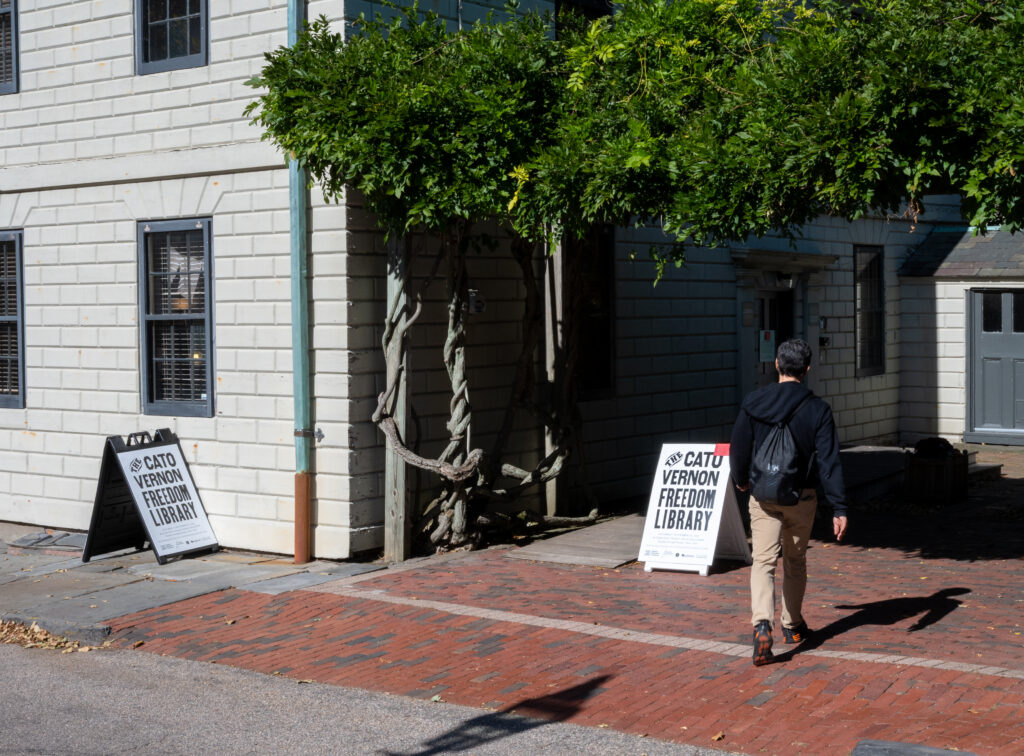
The current project is the Cato Vernon Freedom Library at Vernon House, which sits on the corner of Clarke and Mary streets in Newport, and which is owned by the Newport Restoration Foundation.
While the house is famously known for hosting George Washington when he passed through Newport during the Revolutionary War, the subject of the current interactive exhibition is another man who spent time in the home: Cato Vernon, who was enslaved there as a teenager by William Vernon for a known period of 1774-1776.
According to an article published in the Spring 2026 issue of The Bridge, a joint publication of the Newport Historical Society and the Rhode Island Historical Society, Cato Vernon was born into slavery in Newport around 1759 and spent his childhood and adolescence enslaved by William Vernon, one of the city’s most prolific slave traders.
On March 11, 1778, Cato Vernon enlisted in the 1st Rhode Island Regiment at East Greenwich, where William Vernon had sent him to work as an indentured apprentice to John Glazier, shipwright. This act of enlistment was an act of self-emancipation per the Slave Enlistment Act, which granted immediate freedom to enslaved men who “passed muster” and who joined the Continental Army for the duration of the Revolutionary War.
Cato Vernon served until the war’s end, a period that saw him travel from Aquidneck Island to New York to Pennsylvania before returning to Newport, where he arrived a veteran who was never compensated for his service, despite spending years trying to secure the payment he was rightfully owed.
These details — along with the entire known life of Cato Vernon — are reported by Heather Bollinger in her article for The Bridge: “Carpenter, Mariner, Soldier, Veteran: Cato Vernon and Black Service in the American Revolution.” Bollinger is a Voices Research Assistant at the Newport Historical Society.
Her article helped with the research behind the Cato Vernon exhibit, says Jane Carey, who served as lead researcher on the project for Center Aquidneck. Gina Tangorra, NRF’s director of engagement, already had plans underway to create something around the life of Cato Vernon, but Bollinger’s research helped substantially.
“By wonderful serendipity this scholarly article comes out,” says Carey, who is volunteering as an “Artist-Docent” several days a week for the length of the exhibit, and who now shares what she’s learned about Cato Vernon with interested visitors.
When guests arrive at the Vernon House, whether by happenstance or planning, they are welcomed in and led to a room at the end of a hallway, where a black curtain serves as a door. The Artist-Docents then offer everyone a flashlight and explain that the room contains an audio experience set in the dark. Guests are invited to sit on one of the benches located around the room and listen to a recording by Peter Coriander, who shares the history of the house and Cato Vernon, asking visitors to imagine what life might have been like in 1776. There are moments when guests are asked to shine their light in certain directions, casting a spotlight and inviting contemplation.
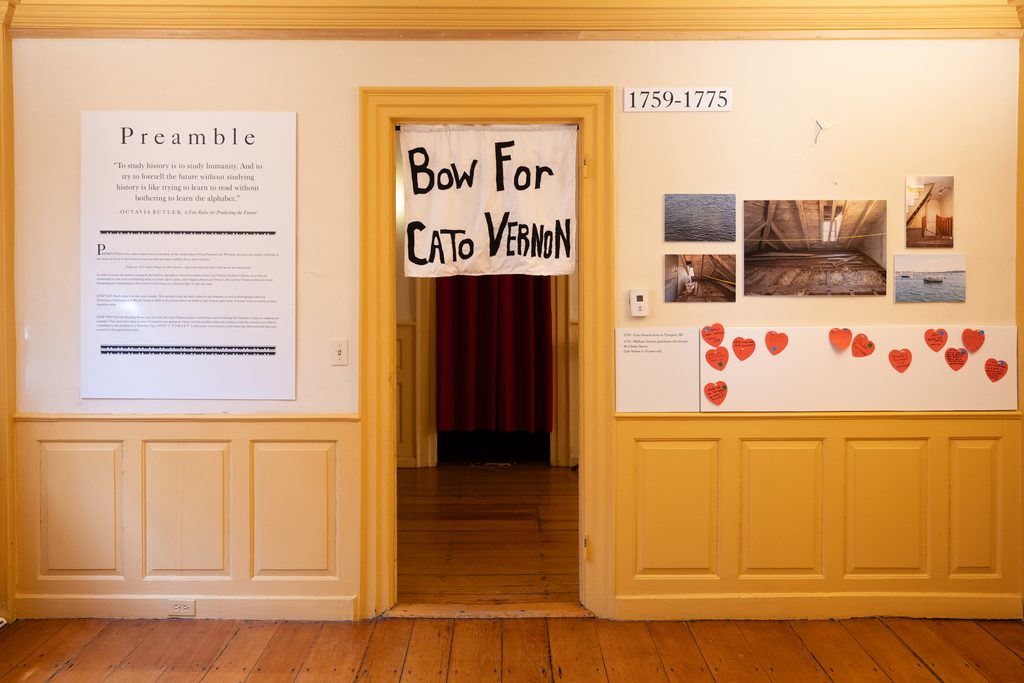
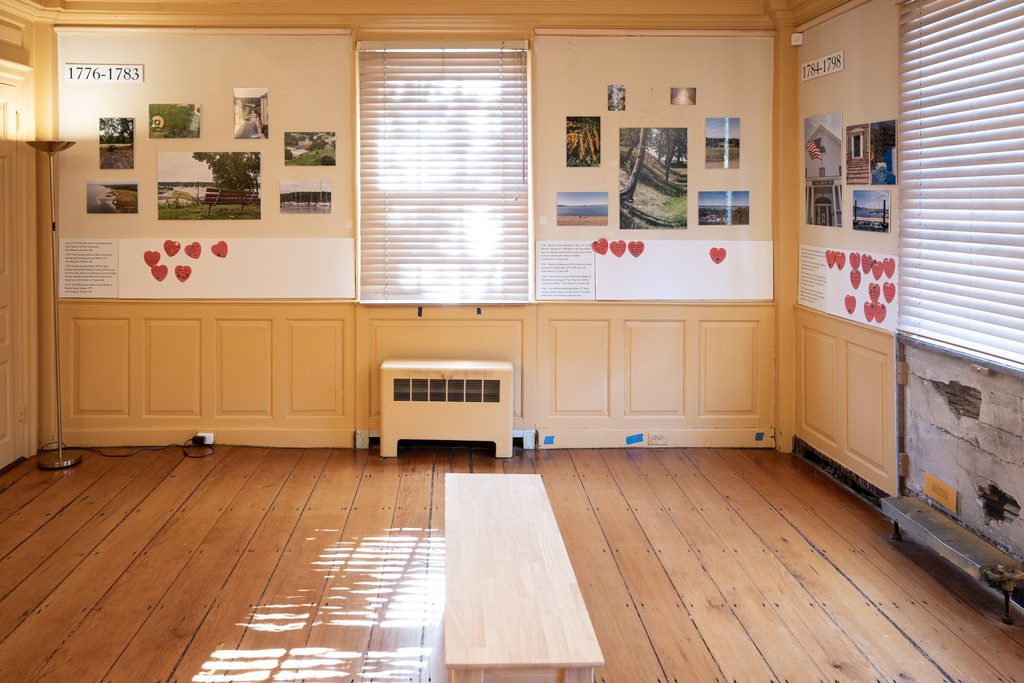
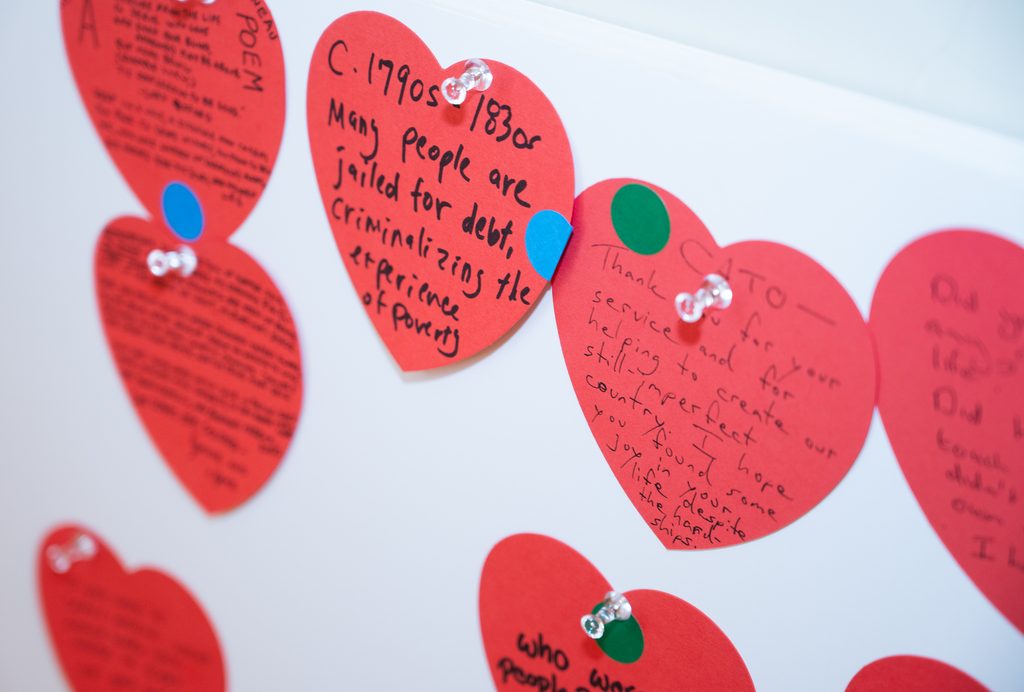
Following the recording, guests are invited to walk across the hall into another room, where a timeline wraps around four walls, listing dates of known events in Cato Vernon’s life. Alongside the timeline appears a smattering of cutout red hearts with messages written by previous visitors. Some of the notes read:
Cato,
If I could ask you a question, I would want to know
what you dreamed about, outside of freedom. What was
your passion?
– Rozy
Rest in Glory friend
And another:
Cato –
Thank you for your service and for helping to create our
still-imperfect country. I hope you found some joy in your
life despite the hardships.
Above the timeline are corresponding photographs providing modern day views of locales Cato Vernon is believed to have passed through, from areas around Newport Harbor to the former battlefield where Portsmouth High School is built. Dominique Sindayiganza, a Providence-based photographer, provided the images.
Noon and Hancock-Brainerd are “comfortable following a project where it leads them,” says Sindayiganza, meaning the photo component evolved as the project evolved.
The final display is “trying to see what happens if we reimagine or revisit some of the spaces that Cato Vernon has passed through,” says Sindayiganza, noting he did a lot of “wondering and wandering,” gravitating to many nature sites. In some ways those are the closest remnants of what he would have experienced: the networks of tree roots are still the same; the water and shoreline are still there.
“There are so many ways to engage with the history, and the remembrance, of who Cato Vernon was,” says Sindayiganza. Sacrifice is inherent in going to war to fight for your own freedom, he says, and in the case of Cato Vernon, “nobody rode off into the sunset and all is well.”
His photos are accompanied by the copy of a letter Cato Vernon sent to his former enslaver, William Vernon, while he was in jail and seeking financial assistance to pay a debt (that jail is now the Jailhouse Inn on nearby Marlborough Street).
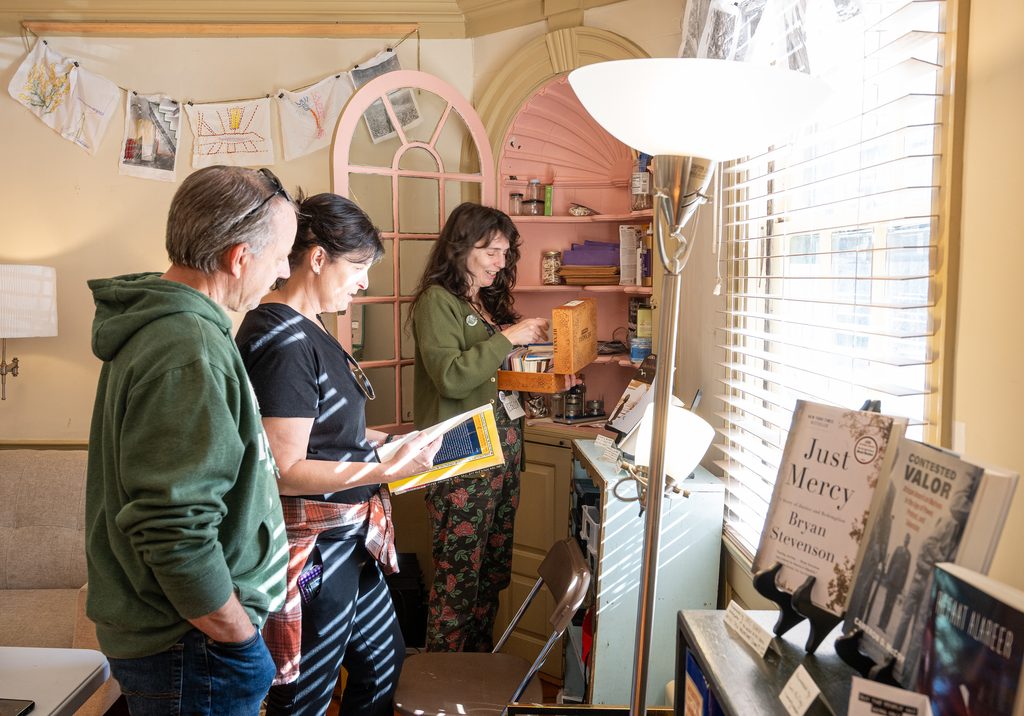
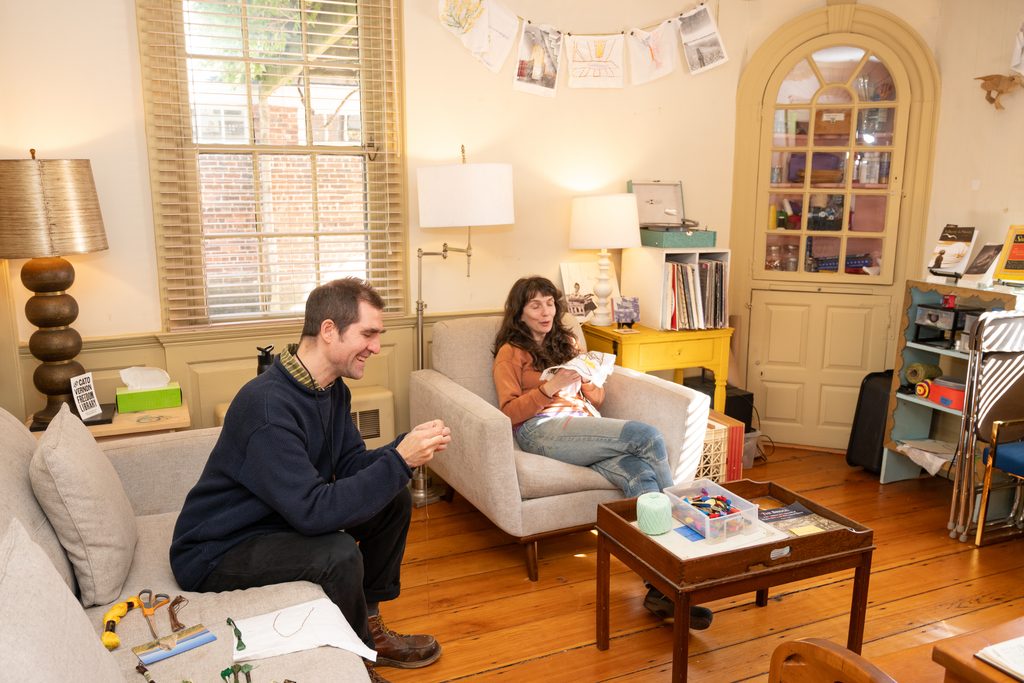
The third and final room consists of “The Library,” which is set up as a cozy and inviting living room: comfy couch, record player with a selection of vinyl, shelves of books, a corner cabinet filled with arts and craft supplies, a table with tea and cookies, a fireplace mantel decorated with art, a wall of photos. All the accessories are intentional and somehow relate to the exhibit, inviting visitors to learn more, whether about Newport’s history, Black history, the experience of veterans or other related topics.
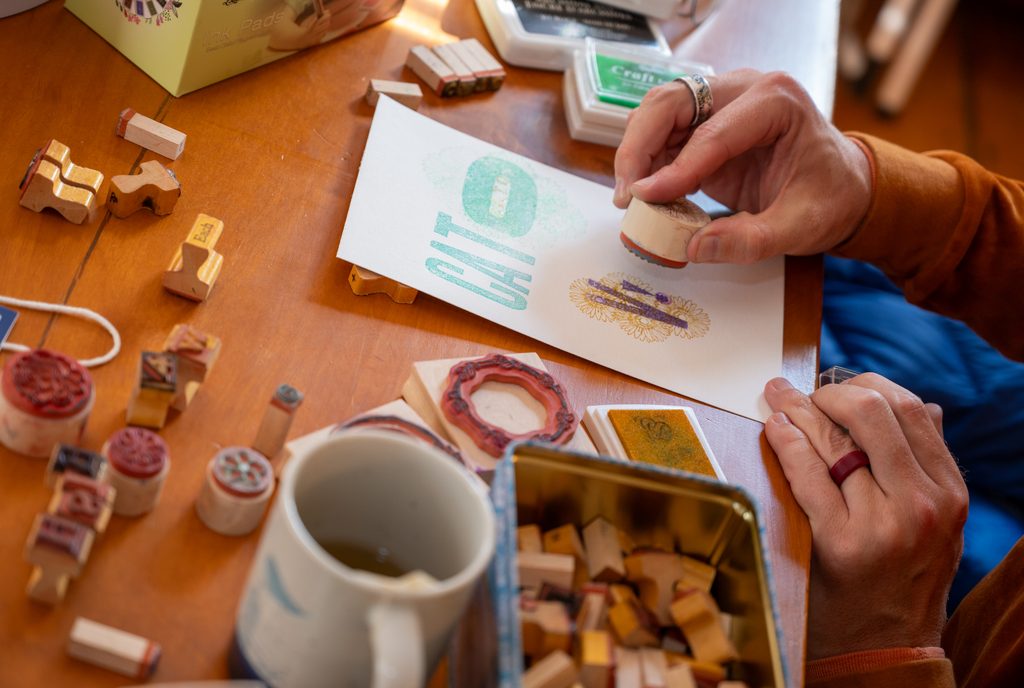
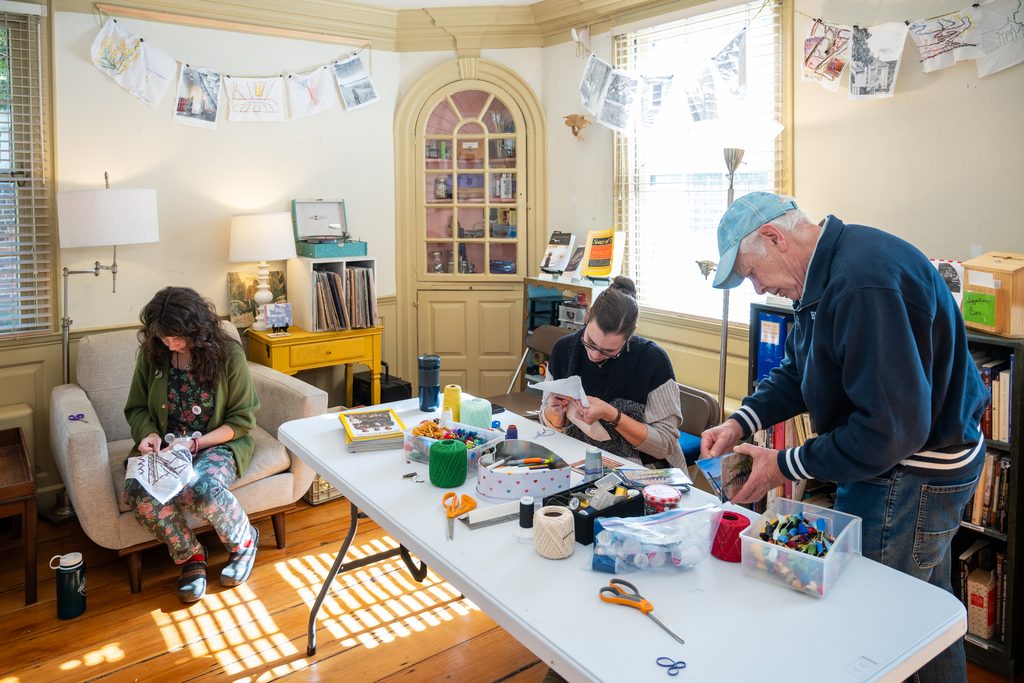
Noon and Hancock-Brainerd also planned a series of programs to correspond with the exhibit — it opened October 3 and closes November 22 —ranging from sewing circles to printing workshops, book talks and mini concerts. On a Saturday in October, 15-20 people convened for a sewing circle led by Providence-based artist Bob Dilworth; they ended up hanging out for hours. “I just thought, how rad,” says Noon. “What a nice way to spend a Saturday. I made a party,” she mused, thrilled and grateful.
As for the Newport Restoration Foundation, “they gave us the most beautiful free rein that any institutional partner has ever done,” says Noon, noting it took a year of planning and regular meetings to bring the Cato Vernon Freedom Library to life.
Past, Present, Future
Several of the collaborators for the Cato Vernon Freedom Library were involved in last year’s “Life After Life,” a live theater production performed at Newport’s Common Burying Ground and God’s Little Acre. An extensive cast portrayed some of those buried in the graves, and guests were guided around the historic cemetery on an immersive storytelling journey. The event was held Nov. 1-2, 2025, and was sold out.
Center Aquidneck’s next offering will be its spring slate of Jane’s Walks, a local celebration of a global event honoring the late Jane Jacobs, an urban writer and planning activist who authored “The Death and Life of Great American Cities.” These free, neighbor-led walking conversations are meant to foster community and connection; they will take place May 1-2, 2027.
Noon and Hancock-Brainerd plan to take a respite the fall of 2027, although they already have an idea percolating for 2028 (one that may or may not involve Anne Hutchinson; stay posted for details).
When not dreaming up projects for Center Aquidneck — and then bringing them to life — they each have a slate of other responsibilities. Noon is the deputy director for Providence’s Department of Art, Culture and Tourism. She’s also on the board of Overlap Art Space in Newport, which recently transitioned to being a nonprofit gallery space. Hancock-Brainerd teaches public speaking and theater at Salve Regina University and works for Bike Newport.
“As artists, ultimately we do the thing that’s most interesting to us,” says Noon. “These days, we want to build a connected community.” To follow Center Aquidneck and its theatrical happenings, visit centeraquidneck.com, where you can also learn more about the Cato Vernon Freedom Library.
EDITOR’S NOTE: This story appears in our current November/December print issue. To read more stories from this issue, find a copy on local newsstands. Here’s a link to local retailers.