Newport Restoration Foundation’s conference returns for tenth year with focus on “Resiliency in the Wake of Climate Change”
Photos by Dave Hansen
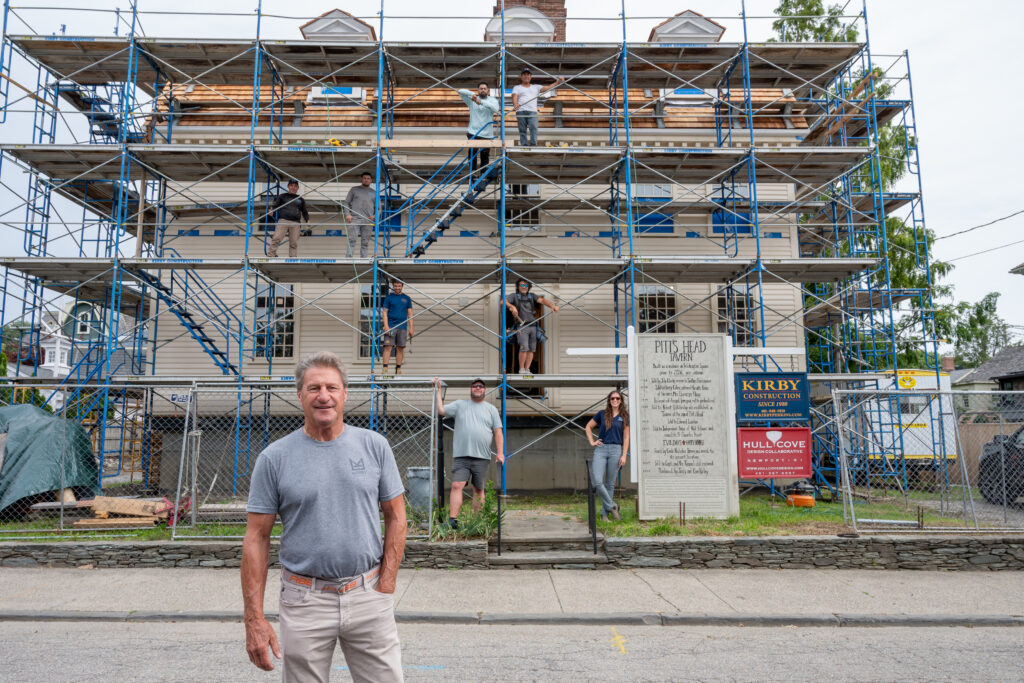
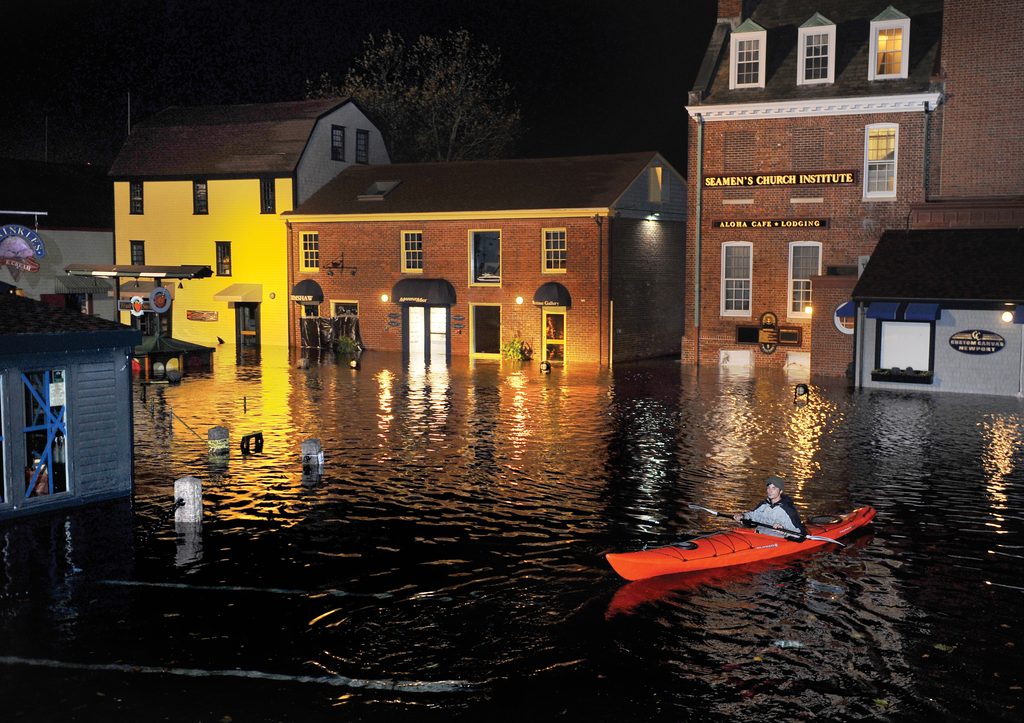
The former Pitt’s Head Tavern, one of Newport’s most famous Colonial homes, was recently raised a story, an action that in the past would be controversial for a structure located in a historic district. But with sea level rise, more intense storms, and tidal surges leading to increased flooding, the rules have changed.
The Newport Restoration Foundation has focused on how to respond to climate change in its Keeping History above Water symposium, an initiative that began in 2016. Since then, the symposiums have been held around the country almost annually. The local foundation will host its second, the 11th overall, at Salve Regina University Oct. 21-23.
“Keeping History Above Water was a groundbreaking conversation when we first gathered together experts in the field and concerned community members a decade ago,” says Hilary Fagan, executive director of the Newport Restoration Foundation. “Now in 2026, Keeping History Above Water is an initiative that has helped to advance resiliency efforts in many communities across the nation, as well as in our own community. It is not only an important conversation but integral to our preservation work in Newport. We look forward to sharing a roadmap to the future of the initiative and NRF’s portfolio-wide resiliency work.”
Jerry Kirby, owner of Kirby-Perkins Construction Co. and the former Pitt’s Head Tavern, says owners of historic homes in Newport’s Point neighborhood have no choice but to elevate their property if it is located in the flood zone, less than 12 feet above sea level, and undergoing renovation or remodeling. Otherwise, they will not qualify for Federal Emergency Management administration insurance, says Kirby.
According to FEMA, there are more than 230 buildings in the Point neighborhood alone that are located within the flood zone.
The Newport Restoration Foundation stewards more than 80 historic buildings and landscapes, including 27 rental properties in the Point and Lower Thames Street neighborhoods, that are vulnerable to inundation. An additional five properties face the threat of three to five feet of sea level rise — totaling 46 percent of the foundation’s rental portfolio, according to its website.
The foundation currently is designing the elevation of one of its historic homes, according to Gina Tangorra, director of engagement. “We plan to make the project and process very public-facing so that homeowners can better understand the process of elevation and have the tools to undertake their own elevation project,” she says, adding that more information will be announced at the symposium.
From Newport to New Hampshire
There are many historic areas along the nation’s coastlines facing the same problems as Newport, mainly due to sea level rise.
Strawbery Banke Museum, which oversees a historic neighborhood in Portsmouth, New Hampshire, hosted a Keeping History Above Water conference in 2023. Rodney Rowland, its director of environmental sustainability, will be part of a panel in Newport titled “Past Host Cities, Insights and Gains.”
Other conferences have taken place in Annapolis, Maryland; Palo Alto, California; Nantucket and Salem, Massachusetts; St. Augustine, Florida; Charleston, South Carolina; Norfolk, Virginia; and Port of Spain, Trinidad and Tobago, where the discussion was held virtually. The Salem conference also was streamed because of Covid-19 shutdowns.
“I have been to all of them, and spoken at at least four of them,” Rowland says. “I went from soaking up every bit of information I could, to now helping others.” He attended the first conference in Newport 10 years ago because the Strawbery Banke neighborhood was struggling with water problems, a struggle that continues.
“Like many historic sites, we are vulnerable to flooding because we are on a body of water,” Rowland explains. “We are museum professionals dealing with history, material culture, and historic preservation, but nothing in our backgrounds has prepared us for dealing with flooding.
“From that first conference it was an opportunity to immerse ourselves in that world, to talk to experts and other institutions and start to formulate a game plan to become resilient against the increasing threat from stormwater,” he continues. “Newport did a super job of getting people started on that path.”
Like the Newport Restoration Foundation, the Strawbery Banke Museum offers residents an opportunity to lease its historic homes, which are located in a low-lying area on the Piscataqua River.
“We have surface water flooding because we are at the lowest elevation in this neighborhood,” Rowland says, “and groundwater intrusion because the river is pushing groundwater into our historic basements due to higher tides.” There was a tidal surge in 2024, he said, and more are expected in future years.
Strawbery Banke is conducting engineering studies to determine what needs to be done to protect each of its buildings. The first project was to replace the foundation of the PenhallowCousins House, built in 1750. “We put in a wet-proof foundation, concrete with an open bottom that allows the ground water to come and go. The interior is waterproofed, with obviously nothing down there,” Rowland said.
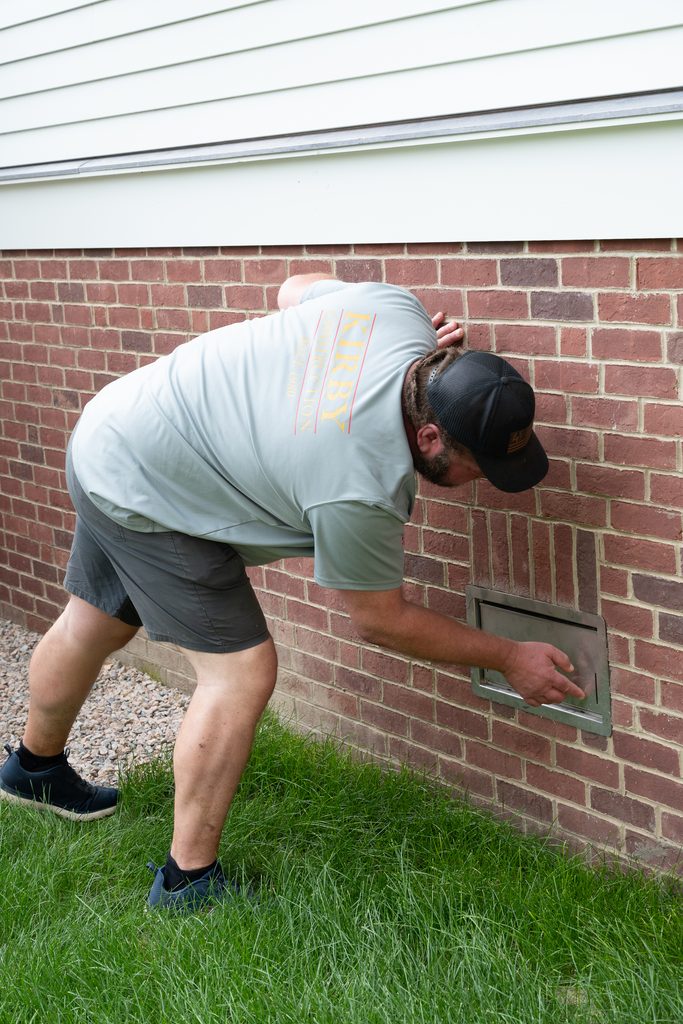
Water can exit through vents on one side of the foundation. There is a sump pump, and a connection to the city’s stormwater system that allows the water to flow out when the tide goes out, he said.
Historic preservationists strive to save every original detail, but the New Hampshire group had no choice but to replace the Penhallow-Cousins House’s foundation, which featured beautiful brick arches supporting the chimney, Rowland said.
“There are a few people who think Strawbery Banke may be shortsighted not to elevate our buildings,” he explained. “But we didn’t create this museum; we are using an existing neighborhood and location as it’s evolved.”
Originally settled by Abenaki Indians, the area was developed over time as the site of everything from a European settlement to a post-World War II, cold-water apartment complex.
“For us to show our visitors that evolution, we don’t want to change the look,” Rowland says. “We are making an informed decision not to elevate our buildings, and it might bite us. Right now, there are other ways to manage our stormwater before we need to do that.”
Raising Pitt’s Head Tavern
When Jerry Kirby raised the former Pitt’s Head Tavern, located on Bridge Street in Newport’s Point neighborhood, he followed the city’s Guidelines for Elevating Historic Buildings. Written by former city Preservation Planner Helen Johnson and Andy Bjork, former chairman of the city’s Historic District Commission, the guidelines were approved in 2020.
They were updated in 2023 with details, photos, and graphics illustrating how residences and commercial buildings may be raised. The project was coordinated by the city and the Newport Restoration Foundation, with National Park Service funds administered by the state. The 72-page appendix is posted on the foundation’s website: newportrestoration.org.
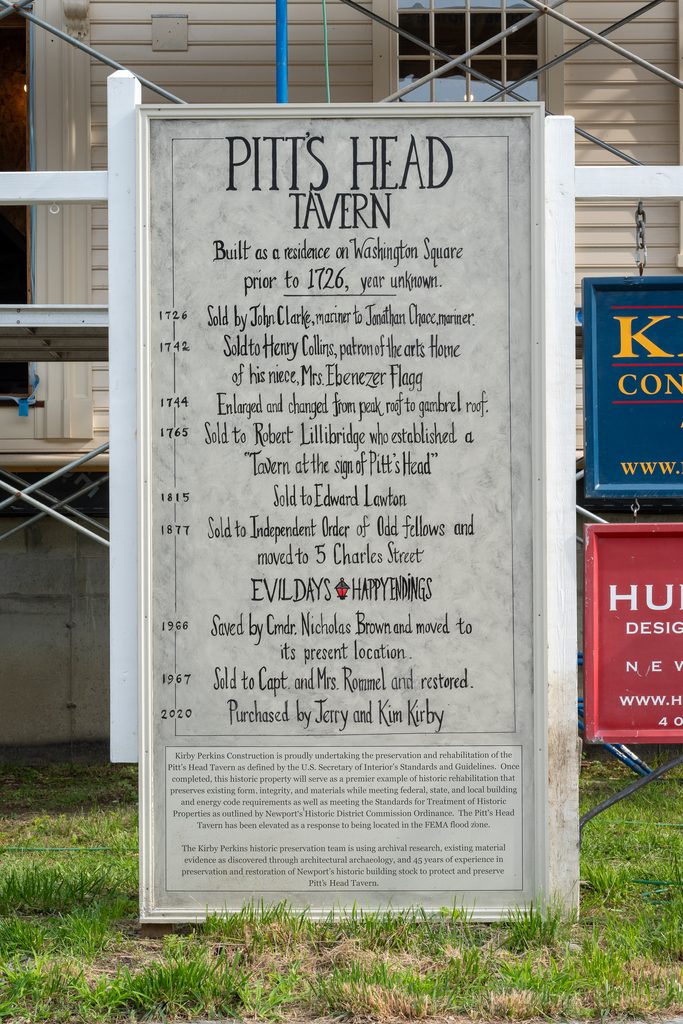
Planner Johnson went from helping to develop city guidelines to applying them; she is now head of historic preservation and project manager for Kirby-Perkins Construction. “When Pitt’s Tavern went up for sale, I didn’t want to see anybody wreck it,” Kirby says. “We kept all the original beams, windows and doors.”
Using dendrochronology, the scientific method of dating artifacts and events by analyzing the annual growth rings found in trees and timber, Kirby determined that parts of the building date to the late 1600s. It was extensively rebuilt in 1726, after mariner John Clarke sold it to Jonathan Chase, another mariner. Robert Lillibridge bought the property years later and established the tavern in 1765. It was named for William Pitt, the British parliamentarian known for defending the rights of American colonists, according to research by the Newport Historical Society.
Built on Washington Square, the structure was moved east a short distance to 5 Charles Street in 1877, according to the historical society. The final move to 77 Bridge Street took place in 1965. Kirby says he plans to resell the building. His construction company is a supporter of the upcoming three-day symposium, which will feature 14 different panels addressing a variety of topics.
A pilot program in Louisiana
Heather Veneziano is an architectural historian and founder of the preservation consulting firm Gambrel & Peak. She also is a professor of historic preservation at Tulane University in New Orleans and will be part of a panel discussing “Living Documentation for Coastal Heritage at Risk” on the second day of the conference.
Working with colleagues at the firm and graduate students at Tulane, Veneziano has been documenting the historic properties and other buildings on Grand Isle, Louisiana’s southernmost island in the Gulf of Mexico. The project uses ArcGIS software to create a digital footprint of the area, and team members are interviewing island residents. CICADA, an architectural firm in Philadelphia, is providing the high-tech components the project needs.
“We’ll have historical maps, high-resolution drone photography, and video interviews on the site,” says Veneziano.
The team plans to document other coastal communities in Louisiana. Federal funding issued through the state, and a grant from Tulane’s Center on Climate Change support the work.
“Hopefully, the documentation will lead to policy changes that will help the communities stay in place longer,” Veneziano says. “One of the initiatives we support is rebuilding marshlands, which absorb some of the initial impact of hurricanes and storms.
“Without that buffer, the places inhabited by people are on the frontline, and more quickly lost.”
Southern Louisiana residents also face increasing insurance rates and premiums, which can be tied, in part, to properties’ elevations, which the project is also documenting.
“It is hard to keep an historic district designation if you want to raise your buildings dramatically,” says Veneziano. “But in some places if you don’t raise a building dramatically, you are not going to have a building because it will flood out.
“There is a lot of back-and-forth. Insurance companies will say we are not going to cover you unless you raise to this specific height. But some historic districts say if you raise that high, we are going to take away the historic district designation. That has to change.”
Preserving Construction
In Virginia, Paige Pollard is co-owner with Kerry Shackleford of Building Resilient Solutions, which works mainly along the state’s Tidewater Coast. Pollard, founder of the Commonwealth Preservation Group based in Norfolk, and Shackleford will host a panel discussion on Oct. 21 titled, “Reducing Disaster Anxiety Through Action.”
“We focus on preserving pre-1970s construction and materials,” says Pollard. “Those materials have been historically more resilient and can withstand flood situations.”
The Tidewater area is prone to tidal storm surge, which flows in and out, she said, unlike the long-term flooding and humidity in New Orleans.
Building Resilient Solutions analyzes mill wood flooring, plaster, brick masonry, and different building assemblies in its lab, testing their ability to survive flooding and the means to dry out the materials. It is known that old growth lumber does not warp and deteriorate as much as modern types of flooring, but all too often homeowners will gut a building and rebuild with the modern, less resilient materials.
“We test materials and put them together in the traditional way they would have been built,” Pollard says. That could be plaster on wood lathes, metal lathes, or brick, for example.
Analysts examine materials in their original state, and after they have been damaged by water and dried out. They’ve found that depending on all the variables, gutting a home is not always the best alternative.
“We try to equip folks with knowledge on how to prepare for a pre-disaster for an easier post-disaster recovery,” Pollard said. “What are the ways they can slightly modify their building, or what to do when they know a storm is coming.”
Since 2018, the company has assisted property owners with persistent moisture problems. At the October conference it will demonstrate how probes it developed provide data about the movement of water within a flooded building. “We are following the needs as they reveal themselves,”
Pollard explains. “There aren’t a lot of folks in the U.S. doing this kind of testing or analysis. It is very site specific, what the flood risk is.”
All-hands-on-deck
Joe Christo and Katherine Dafforn, colleagues at the Stone Living Lab in Boston, will speak Oct. 23 about a real-time monitoring network along the Massachusetts coast. The two will be part of a panel titled “Nature-Based Approaches to Coastal Resilience.”
“We have 22 different instruments along the shoreline of Boston Harbor and throughout eastern Massachusetts that help monitor flooding and changing climate conditions,” says Christo. “This is especially relevant for the conference because this type of network helps people understand changing conditions better and develop adaptation planning for them.
The instruments were installed over the past three years. Stone Living Lab is conducting the project in partnership with Boston Harbor Now, the University of Massachusetts School for the Environment, the city of Boston, multiple state and federal agencies, and a nonprofit foundation.
“We’ve seen some really significant flooding and storm events that we’ve been able to capture and share with our network to help them better understand what is happening in relation to climate change,” Christo says.
The instruments show wave heights, wind speeds, and specific flooding conditions along the shoreline. Any flooding detected on land can be viewed on a phone dashboard.
“People see when and how flooding is happening in urban areas,” Christo said. That information allows them to prepare and mitigate impacts.
“At the conference, we will explain how Stone Living Lab operates and how we are a unique partnership,” he said. “We feel it is really important to emphasize that climate adaptation and climate resilience requires an all-hands-on-deck approach.”
The panelists know they are working against time; they are aware of the inevitable trend toward water inundation in the future. Climate Ready Boston, an initiative currently underway by that city, reports the relative sea level rise from the present to 2100 could be 2.4 feet to 7.4 feet. The average annual cost of damages along New England’s coast from storm-generated coastal flooding could be as much as $1.39 billion by 2070.
There are similar projections nationwide.
“Our work can be used now for disaster response and for preparedness,” Veneziano says of her work in Louisiana. “But we also want a long-term record of the existence of communities like Grand Isle because we know it is just a matter of time before they are lost.
“We want to look at the environment holistically, all that is of value to the people living there. What areas of their culture and history do they want remembered?” Rowland says he believes preservationists in his state of New Hampshire and throughout the country are making progress in their efforts to protect historic structures, museums, and landscapes from rising sea levels and other problems caused by climate change. He credits Keeping History Above Water with contributing to that success.
But casualties are inevitable, he says.
“The sad news is we are going to lose parts of our history. There is no escaping that,” according to Rowland. “There are going to be hard decisions about what we can save and what we cannot. That’s just reality.”
For more information about the conference, visit newportrestoration.org.